
Rabbi Wayne was one of the great original thinkers, a deep scholar, always searching and seeking, never satisfied with the status quo, never content with having “arrived,” ever-curious and hungry, always wanting more.
His masterful theological work, The Real Name of God, was published in 2012, the culmination of seven years of research and questing. Up until the day it went to press, he continued to turn it inside-out, add to it, deepen the perspective, challenge his own thinking. He desired nothing less than truth, and with an awesome strength, wrestled as much as he could of it out of the Divine.
The Real Name of God is the story and theological chutzpah of that seven-year (probably lifelong) wrestling match. It is not a light or easy book. But it stands firm in demanding an audience with the deep knowings of our hearts and souls. And so, like any complete journey, joyously brings us Home.
Always believing he needed to do more, Rabbi Wayne also wrote a pocket-size Anochi Prayer Book, and made a CD of Anochi Chants to accompany the book. Thanks to amazingly devoted friends in the community, last week we did the intense garage archeology to find all of Rabbi’s books – and all of them will soon be available to you. I will send you a complete listing of all that we have, and I thank you for your interest and your patience!
As I culled the significant gems from his gorgeous teachings for this Legacy Piece, I remain in awe of the immensity of Rabbi Wayne’s courage and vision, as he questioned all of it – no matter what it cost him, personally, professionally, physically, emotionally.
In his name, I offer you pieces from The Real Name of God – so that you may join in Rabbi Wayne’s Divine wrestling match with as much chutzpah and wonder and delight as he enjoyed.
In this season of giving thanks, please know how very grateful I am to have the honor and privilege of knowing you and walking with you in this life. Thank you.
Ellen, continuing the work of the Elijah Minyan
Excerpts from The Real Name of God
by Rabbi Wayne Dosick, PhD
The Hebrew Bible — in its original language and its hundreds of translations — is the best-selling book of all time.
It is the core text for Jews, Christians, and Muslims — all of whom are sourced in the Abrahamic faith of the Bible, and it is the premiere and foundational masterpiece of all western literature.
It is so beloved because it touches our minds and hearts, telling the story of God, the universe, and humankind — the record of our history, the blueprint for our existence, and the design for our destiny.
Yet, some consider the Bible to be disturbing and disquieting; its tales and accounts pure fantasy, its characters seriously flawed, its main character demanding and capricious, and its lessons holding little if any moral authority. Throughout its long and storied history, many have seen the Bible not as a fount of guidance and inspiration, but as a source of conflict and strife between peoples and communities across the globe.
Either way — both ways — even in this highly rational, scientific, technological age, for good or for ill, the faith-based Bible captures the human imagination, and remains of immense interest and great import to people and societies throughout the world.
The Bible begins with the assumption of the existence of God. It tells us what God does; it tells us about God’s characteristics and attributes; it tells us God’s word and will.
But, the Hebrew Bible does not tell us who God is.
None of the names we have for God in the Bible — nor any of the names by which God is later identified and known — is God’s real Name — the wholeness, the totality, the full Essence of God. And since “you don’t know something until you know its ‘name’,” we have never wholly known the real God.
Hello
Hello. I’m Wayne Dosick.
I, like you, am a child of the universe, a child of God.
Here, for most of my life, my main connection to God, my primary pathway to God, has been through religion.
I grew up in a home where my parents showed me how to observe Jewish rituals and traditions. Since I was a little boy, I have attended synagogue, prayed Jewish prayers, and observed Jewish holidays, I went to Jewish schools, learned Hebrew, and studied sacred texts. I was active in the synagogue youth group, and journeyed — again and again over the years — to Israel.
I learned to pray to Adonai Elohenu, “the Lord our God,” the God of the Hebrew Bible, who has been embraced and sustained throughout the millennia by Jewish law and custom.
Then I went to seminary and became a rabbi. I learned, and prayed, and meditated, and chanted, so that I could develop and build a personal relationship with God — the God of love, and care, and compassion whom I remember from “Before;” the God I knew in the Heavens before I came into body on this Earth.
For almost four decades, I have tried to help guide people to their own personal relationship with God, by celebrating God’s living Presence. I have led worship services, and, in every possible setting, taught about Judaism to everyone from the youngest to the oldest. I have officiated at weddings and funerals, presided over community functions, and I have written books about Jewish faith and practice — all with God at the center, and faith at the core.
Yet, for a long time, I stood on the pulpits of those suburban congregations, looking out at the folks in the pews, and I realized that it was “not working” for them. And, eventually, it began to “not work” for me.
Why?
I have a big problem with God.
Not the God with whom I lived in the Heavens.
Not the God I remember from there.
Not the God of personal intimacy.
But, the God whom we all meet on Earth in the places where God has chosen to be revealed and known — the Bible, the prayerbook, and holy writings.
I am very uncomfortable with the God whom I meet in the Bible, and to whom prayer is addressed — the God who is venerated and worshipped as Creator, Redeemer, Commanding Law-Giver, and Sustainer.
In one glorious aspect, the God of the Bible is a God who creates human beings in the Image of the Divine; who celebrates the human spirit; who gives grand and majestic laws for the highest ethical behavior; who invites human beings to be partners in the work of the ongoing creation and betterment of the world; who makes even the most mundane human interaction sacred; and elevates the ordinary to the holy.
Yet, those noble aspects of God are far too often overshadowed by a God who is, in great part, a rigid, militaristic, hierarchical, male authoritarian. It is God who brings plagues, and kills firstborn, who throws temper tantrums, and metes out harsh punishments, who opens the ground to swallow up opponents, and makes war to obliterate enemy nations. It is God who gets angry and is jealous and vengeful, and makes outrageous demands, and, frankly, behaves very badly. It is God who, in later manifestations in other faith communities, inspires crusades, inquisitions, and holy wars; in whose name is preached fire and brimstone, hell and damnation.
That God is not my God. My God would never act that way. God — the one I know personally and intimately — is total perfection and pure love. My God cares, comforts, protects, and balances justice with sweet compassion. My God is Spirit, and Goodness, and Righteousness.
I am well aware that God has many aspects and attributes.
Throughout the centuries, various faith groups have attempted to meld God’s seemingly contradictory nature. The Jewish mystics focus on God who loves and embraces. In its beginnings, Christianity tried to balance the demanding, law-giving God with a God of Love; a God who has three inseparable yet distinct faces — Father, Son, and Holy Spirit. Islam tried to synthesize the God of law and the God of Love by proclaiming One (newly named) Godhead, but succeeded, rather, in providing a third vision of God.
There are those who, for themselves, have successfully integrated the many characteristics and behaviors of the biblical God into a satisfactory and satisfying relationship of belief and practice.
But, for me, there has to be a better answer — rational, emotional, and spiritual — that explains the wildly differing behaviors of God. And all the old canards — “God has many different characteristics, and He can display any one of them whenever He chooses:” or, “God is God; He can do whatever He wants;” or, “It’s God’s will” — just will not do. There has to be a solution to the mystery of God’s paradoxical character that we have just not yet seen, or been able to comprehend.
I know that I am not alone. There are so very many Jews, Christians, and Muslims — you! — who are all sourced in the Abrahamic faith of the Hebrew Bible who feel the same way.
That may be one of the reasons that our synagogues, churches, and mosques are not overflowing with worshipers. When we go to pray, to whom are we speaking? When we seek God, whom do we find? When we read sacred Scripture, where do we find the God of “abounding love,” rather than the God who is “a man of war”? No matter what the evolving theologies of Judaism, Christianity, and Islam have tried to do to change the image of God — and some of the attempts have been very successful —the original biblical text endures, with its image of a powerfully foreboding God.
So, over the years, I immersed myself in study and envisioning. Over and over again, I have delved into biblical text — its language, legends, and laws; its theologies, I have read the works of scholars, sages, and mystics of many disciplines and traditions.
My prayers, and meditations, and dreams have taken me to the depths of doubt, and to the heights of revelation. I have listened and listened to the “still small Voice.”
Why Now?
There are moments in history when accumulated wisdom and conventional thinking give way to the great leap of knowing beyond knowing; to the white spaces between the black letters; to the silence between the words. Human consciousness expands to discover and embrace what has always been there, but is only-now revealed.
This is one of those moments.
Evolving human consciousness, that has brought us to a pinnacle of human intellectual, cultural, scientific, and technological achievement, now brings us to this pivotal juncture when the eternal truth of God’s real Name that is embedded deep within our soul memory, and the archetypal knowing of the real God that is at the depth of our collective unconscious, “bubbles up,” manifests, and is proclaimed.
For, despite living in a world that often seems to hang on the precipice of painful and chaotic self-destruction, it is also a time pregnant with the possibility that the age-old promise of a messianic world of faith and love can be ours. We come with God to embrace and fashion God’s greatest vision: the long-awaited moment when all God’s children will touch hands in peace.
There are moments in history when accumulated wisdom and conventional thinking give way to the great leap of knowing beyond knowing; to the white spaces between the black letters; to the silence between the words. Human consciousness expands to discover and embrace what has always been there, but is only-now revealed.
This is one of those moments.
Who is God?
God is called by hundreds of names.
The Torah — the Five Books of Moses — has multiple names for God. The second two sections of the Hebrew Bible have many more. In later literature of Jewish law, legend, and liturgy, God is called by numerous additional names.
While Christianity and Islam each have one primary name for God, both also have scores more.
Who Is God?
I believe: None of the names we now have for God in the Bible — nor any of the names by which God is later identified and known, or any of the names by which God is called — is God’s real Name.
God is the Wholeness, the Totality, the Oneness of the universe. God is the Everything of the Everything — male and female, light and dark and shadow, us and other, justice and compassion, pain and comfort, sense and nonsense, good and evil, life and death and eternal life. There is nothing in the universe that is not God. God is the Source of All. God is All.
And this is the problem with the traditional biblical names we have for God. Each name is only a part, an aspect, a characteristic, of God. None of the names that we know is the name of the whole, full God-Source.
So, in English — especially in the recent years of the “new age” — God is often called “Source.”
Picture a beach ball.
There is one beach ball, made up of many different colored panels. The whole beach ball is the totality, the wholeness, of the ball. Let’s call the whole beach ball, “Beach Ball-Source.”
The colored panels are each a part, an aspect, of the ball. Without each and every panel, there is no ball. Without the existence of the whole ball, the individual panels have no role.
Now imagine that God is the Divine Beach Ball: the wholeness, the totality, the full essence of God. God is Source.
Each Divine Beach Ball panel is an aspect, a different attribute, of Source. All the names of God we know are the individual aspects or characteristics of Source. Each name we call God is really only one part of Source.
So, if we want to know God’s real Name in the Bible, and, thus, know the real God, our challenge is to answer the simple, yet profound, question:
Who is the Divine Beach Ball?
Who is God in all of God’s fullness?
Who is Source? Who is God?
If God is the Wholeness of the Totality of the universe — and God is; and if God is the Source of All — and God is; then what is the name of Source in the Bible? What is the biblical name of God-Source?
Using the image of the Divine Beach Ball, we have the names of many of the colored panels — the aspects of God-Source. But, what is the name of the Divine Beach Ball?
Is there a biblical name for Source, a name that holds the Wholeness of God? Can we go back all the way into the Bible itself, to find the name of Source, the real Name of God, that has been there all along but, until this moment in evolving human consciousness, we have not been able to see?
What is the biblical name of Source?
What is the real biblical Name of God?
The Hidden Name
Source — the real Name of God in Bible — is ANOCHI (pronounced AH-NO-CHEE; the “ch” is pronounced as a guttural, as in the name of the composer Johann Sebastian BaCH; the “i” is pronounced as a long “e” as in bee or see.)
Anochi is literally translated from the Hebrew as “I” or “I Am”.
Picturing God as the Divine Beach Ball, Anochi is “I-Source” — the Wholeness, the Everything, the complete Essence of God.
In the Hebrew language, there is another word, Ani, (ah-nee) that means “I.” Ani is a simple declaration of first-person singular.
Anochi holds the much more complex richness of “I, Myself; the Wholeness of My Being; the ‘Me-ness of Me,’ the full ‘Essence of Source’.”
God’s revelation — and, thus, the perception and understanding of God — is fully given, but it would not be wholly perceived until some future time, when human consciousness had evolved enough to grasp and meet the Totality, the full Essence, of God. Now is that time.
So, who is Source?
Who is God?
Anochi is God.
“I” is God.
Torah Tells
There are 141 uses of the word Anochi, in 135 verses, in Torah.
There are another 218 uses of the word Anochi, in 200 verses, in the second and third sections of the Hebrew Bible, Prophets and Writings.
By translating Anochi as “I-Source,” or “I Am” we come to a much greater understanding of the text, and a sense of the Presence of the whole, real God.
We see the crucial places where Source, Anochi, I-Source inserted the Wholeness, the complete Essence of God — the GodSelf of God — into history. These are the moments when no single aspect of God is enough, no deputy of Source can do the job. These are the moments when only Anochi, I-Source can act.
Every time Anochi is used in Torah in the Voice of God, it is when the Fullness of God, the Wholeness of Source, comes to articulate the most important core of God’s teachings and guidance. Anochi is the Great I Am Presence.
Of the 141 usages of Anochi in Torah, less than half the time it is the Voice of God speaking. The other times, the word Anochi, comes from the voice of human beings.
Herein is the multi-layered richness of the name Anochi. Most of the time in Torah when a human being is speaking in the first person, the Hebrew word Ani — the simple form of “I” — is used.
In those instances when a human being uses the word Anochi to refer to self, it is used to denote the GodSelf of the human being who is speaking, the qualities and characteristics of God that are inherently embedded in each and every person.
Anochi in an individual human being — in you and in me — is I-Source within I; God Within me; my GodSelf within MySelf.
We know that Anochi, I-Source, The Great I Am Presence, is the supernatural, transcendent God. That God dwells within us as the immanent God, the God who is as close and as intimate as our very breath, but who maintains the singularity and uniqueness of the Divine Entity, the sole GodHead.
In another time, the notion of God Within may have led some to believe that human beings are God. It is only in this time of evolving human consciousness that we can move beyond the ego-identification that “I” could be God, that Anochi-I might mean that I Am God. Until now, Anochi, the real Name of God has been hidden.
The real Name of God is genderless. Or, better, it contains both genders. Since God is neither male nor female, but the all-encompassing Whole, all of us who are created “in the Image of God” — especially feminists of both genders — will no longer have trouble relating to God who, until this time, has been almost exclusively identified as male. We will no longer have to wonder about — or struggle with — calling God “He,” “She,” or “It,” and we will no longer have to be stuck in ancient ritual formulae that address God only in the masculine.
And, at this very moment in time, when the diverse forces of the universe are slowly but profoundly coming into the Oneness that will transform Earth into Eden, having the genderless Name of God heralds the weaving together of the Divine Masculine and the Divine Feminine that is taking place in the Heavens and is being reflected on Earth. “As Above, so Below.”
The real Name of God teaches us that God is not just the supernal, transcendent God of the Heavens, the God of creation, revelation, communal covenant, and ultimate redemption. Knowing the real Name of God teaches that God is also the immanent God — the God Within; the God who is deep inside each and every one of us; who is in personal, intimate, love-relationship with us, and is our personal salvation.
We can know God and be with God from “the Inside of the Insides,” because God is the very center of our beings.
And, God needs and wants all of us to be of the Divine; God wants us to reside at the Heart of All Being. Just as God is Within us, you and I are Within God. We are at the very center of God.
And, perhaps, most exciting at this moment in time: The real Name of God is based in the Hebrew Bible, that is the shared theological source of all three major western religions that trace their beginnings to Abraham — Judaism, Christianity, and Islam.
Thus, the real Name of God is shared by all three religions, affirming a commonality and a unity that circumstance and situation have oft-times caused us to ignore or forget.
Despite the many different and dear names by which we know God and which make God known to us; despite the singular and unique names by which individual faith communities call God; despite the very beautiful yet distinct paths to God that each religion creates, we know: God is One.
While Judaism will continue to call God Adonai, and Christianity will continue to call God Jesus, and Islam will continue to call God Allah, we now have the One Name for the One God that we can all call God. Three faiths — One God.
In a world where diversity often threatens to tear us apart, and where togetherness and unity is the only path to a world of righteousness and goodness, harmony and tranquility, peace and love, knowing and sharing the real Name of God is a giant leap toward Wholeness, Holiness, and Oneness.

Addendum: The Word
All this is affirmed in the word Anochi itself.
We know that one of the beauties of Anochi is that it is a genderless Hebrew word. It holds the wholeness of both the masculine and the feminine aspects of God, the complete Essence of Source, of I-Source, of the great I Am Presence.
Also the four Hebrew letters of Anochi represent:
Aleph I
Nun We
Chaf You
Yud Me
Here is the totality of human relationships, making Anochi the ultimate paradigm of Martin Buber’s teaching of the “I-Thou” relationship. For, if we can be in an “I-Thou” relationship with another human being, then, surely, we can be in an “I-Thou” relationship with the “Eternal Thou” — Anochi.
In the imagery of the Hindu-east, the “I-Thou” Anochi relationship carries the energy of “Namaste” — the God within me acknowledging the God within you; my GodSelf honoring your GodSelf.
The four letters of the Name Anochi also represent:
Aleph the awesome silence that precedes creation,
Nun the soul of every human being,
Chaf the majestic crown-place where God and humankind meet, and
Yud the merging, the union, of God and God’s children into an eternal Oneness.
And using gematria, the numerology of Hebrew letters, the numerical value of Anochi (adding up the number assigned to each Hebrew letter) is 81, a perfect 9 times 9.
Aleph = 1
Nun = 50
Chaf = 20
Yud = 10
81
In universal numerology, 9 represents universal wholeness and completeness — the very meaning of Anochi who is I-Source.
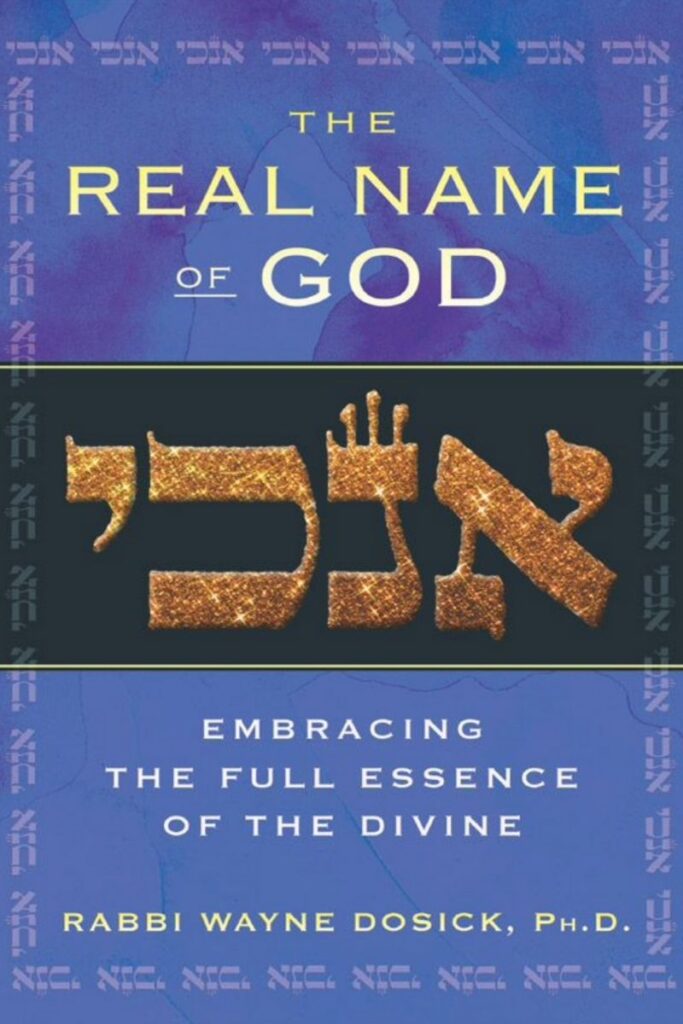
The Real Name of God
The revolutionary discovery of the Biblical Name of the Whole, Complete God, so that we can know the grand God of the universe, and the Inner God of breath and soul. This is a journey on pathways of mind and spirit that brings each one of us into a deep, personal intimate, loving relationship with God, and closer to a world of Oneness. (Inner Traditions, 2012)