
Even as Rabbi Wayne gave us the sweet gift of Seggy and Doogla as a sort of beautiful Holiday present at the end of 2025, so at this extremely painful time in our world, he has the grace and wisdom this month, to bring us directly into the searing central questions of the Here and Now.
At the New Year 2026, our world took a dive into a level of craziness that is disturbing and shocking in ways we haven’t experienced in a long time. Notions of morality, compassion, Right and Wrong, Truth, and the Rule of Law seem to have disappeared. It is as though the Divine has handed each person on the planet a personal invitation to step into their own Divinity and emPowerment, and rise into a Higher Consciousness — NOW.
Rabbi Wayne never sidestepped the Truth. I never heard him veer away from What Is. He had an amazing ability to clearly know what was in Right Action, and what was even slightly out of Integrity.
He wrote his final big book, Radical Loving, during the Pandemic, and it was published in 2020. It is a great and inspiring sonnet to “One God, One World, One People”. And it is so beautiful, many people told me that they cried all the way through it, because it so gloriously reflects back to us those Truths that are the wise knowings of our hearts.
But for this month (in his inimitable way of never shying away from What Is), Rabbi Wayne wanted the Legacy Piece to be — what I think — is the most challenging and painful chapter of the whole book. It is just two pages long — but packed with deep and perhaps even controversial thinking. It has the capacity to make for a very meaty conversation and discussion, and I know it speaks to where each of us is right now, as we attempt to grapple with What Is.
I am so grateful to be taking the walk at this time with you, the precious members of our community, and I so look forward to hearing your thoughts.
Ellen, Continuing the Work of the Elijah Minyan
A Painful Truth
From Radical Loving
Rabbi Dr. Wayne Dosick
Even with our fondest hopes and fervent desires, even with our most Radical Loving and Awesome Holiness, sometimes — many times — wholeness can be elusive. Differences are sharp and stark; reconciliation and healing cannot come to be.
In places where the darkness is so dense and deep, then light cannot possibly penetrate. In places where hatred is so great and strong, where intervention is futile, then the fires of loathing have to burn themselves out by themselves.
In places in our own lives where abuse, betrayal, broken trust, violation, or abandonment has been so hurtful and painful, then resolution may never come.
Words and acts against us may be totally deplorable and inexcusable. Some people may be too toxic for us; some may break our hearts and crush our spirits. Tragically, sometimes people and places are unredeemable.
Yet, we cannot allow anyone or any memory to drag us down or hold us back. Sometimes, it is best to cut all ties, and walk away from whatever and whomever has appalled and aggrieved us. And as antithetical as that may seem to our quest for unity and harmony, it is perfectly all right. For, we are breaking free from ties that bind, protecting our psyches, and reclaiming our own power.Still, the reality of pain, the oft-perceived stigma, the ongoing personal and societal reverberations, and the burden of memory may feel as if they are too much to bear.
As hard as it is to imagine, perhaps the way to our own solace and tranquility is to forgive. We do not have to carry the hurt and the pain. We do not have to wallow in the wrongs done to us and the prisons that our own minds may create for us.
“For-give” means to “give back.” We can return our soul-burden to its source by offering compassion, absolution, exoneration to the one who has harmed us. We can always hope for penance and atonement from our perpetrator. And even if it is not offered, we can experience release from our own anguish, and redemption from our travail, because we are choosing to let go of that which holds and binds us.
Yes, the nobility of human forgiveness can be offered in this Earthworld. But as much as we may try, sometimes, forgiveness is just not ours to give. The offender is too evil, the pain and woundedness too great, the repercussions too massive.
There is a higher and more effective pathway to forgiveness. For ultimately, granting forgiveness belongs to God. It is up to God to forgive those who have harmed us. And it is up to God to accept our inability to forgive.
When we do not want to hold the pain any longer, we can give it to the One with the big enough shoulders and heart to take on all our horrors, agony, and tears. God is always ready to receive whatever we need to give away, whatever will unburden us.
We need not rationalize, or pretend, or forget, but there are times when it is best — as difficult as it may be, and as significant the ripple of consequences may become — to let go and give away to God whatever torments us. With God’s help, we never need be hapless victims. We can always be triumphant survivors who have the power to sever ourselves from our suffering and sorrow, and find a modicum of peace.
If we break off relationships with those who harm us, what does that mean for our quest for wholeness, for Oneness?
We know we can have wide differences—as abhorrent as some of those differences may be to us — so long as we remain civil, respectful, and non-violent. This surely does not mean that we will sit quietly by and simply accept intimidation or coercion thrust upon us, or the abominations that are perpetrated upon us, or the evils and ills that beset our world. And we will not countenance harm or defilement that is done to any one of us.
Instead, we can be Light and Love. We can champion and embrace the compass of morality, and we can call the world to goodness and righteousness. We can work to weave together disparate and contentious pieces into a loving and holy whole.
As the Kotzker Rebbe taught, “There is nothing more whole than a broken heart.”
A monkey in a tree hurled a coconut at the head of a traveler.
The traveler picked up the coconut, drank its refreshing milk,
ate its sweet flesh, and made a bowl from its sturdy shell.
And the traveler continued on the journey.
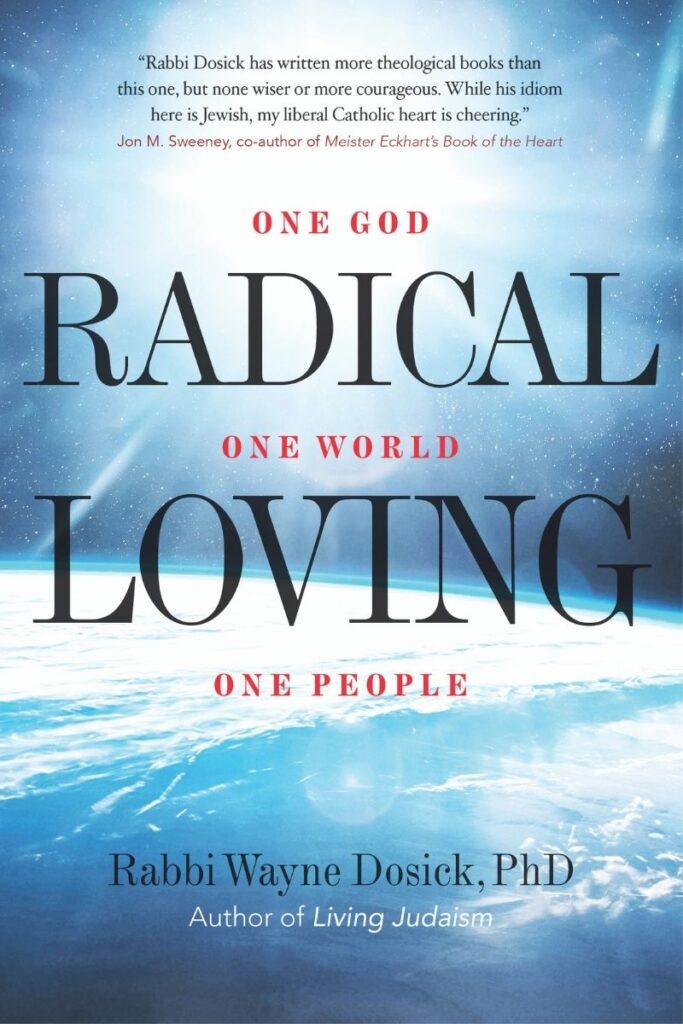
Radical Loving – One God, One World, One People
For many of us, it feels as though our world is breaking apart. Long-held beliefs are being shattered, and we face unprecedented questions and challenges. How do we heal harsh divisions of class, race, religion, and culture that plague us? How do we vanquish sexism, rigid fundamentalism, unabashed nationalism, senseless hatred, and violence? How do we save our precious planet? This book is a bold, visionary blueprint for the redemption, transformation, and birthing of our emerging new world through Radical…